
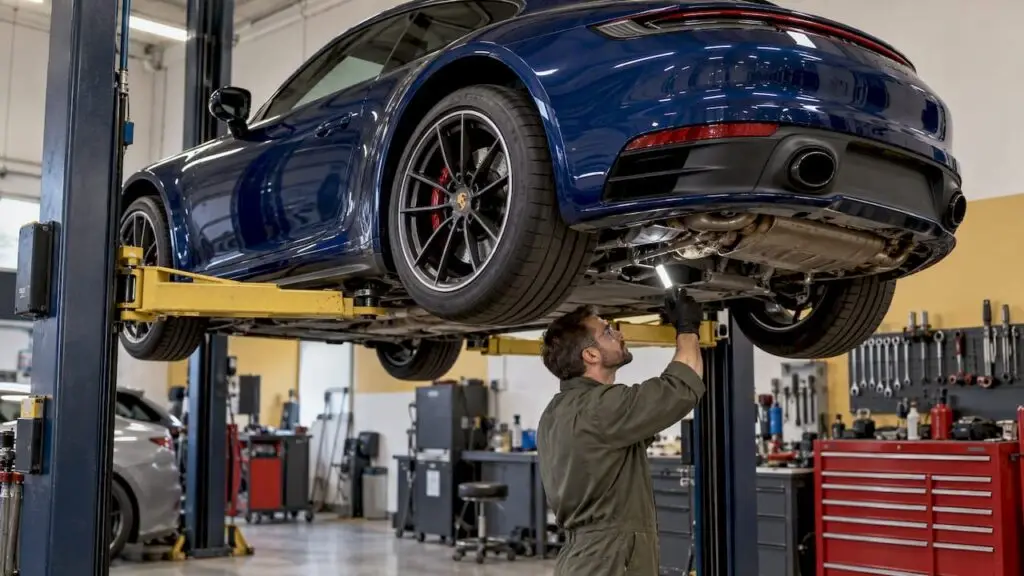
A pre-purchase inspection (PPI) is a hands-on evaluation of a used car by a qualified mechanic before you buy it. It looks for existing faults and likely near-term repairs, and it gives you a documented basis for negotiating or walking away. NerdWallet describes it as a comprehensive evaluation that can identify current problems and potential future issues. For a BMW, Porsche, Mercedes-Benz, Audi or other performance car, it is the single best use of a few hundred dollars before you commit to a purchase that can carry five-figure repair exposure.
This guide explains what a PPI covers, what you can check yourself first, what to ask for on BMW and Porsche models, what it costs, and how to read the results. It is written for buyers in Dallas and across the Dallas-Fort Worth area, where used luxury and performance cars change hands constantly and heat, stop-and-go traffic and highway speeds all leave their mark.
TL;DR
- A PPI is a mechanic’s inspection and diagnostic scan done before you buy, ideally at an independent shop you choose, not one the seller picks.
- A vehicle-history report and a dealer’s “certified” label do not replace it. The FTC recommends an independent inspection in both cases.
- On a BMW or Porsche, insist on a scan of all control modules, a service-history review and a test drive that loads the drivetrain, brakes and suspension.
- Expect to pay roughly a few hundred dollars and to wait about an hour or two. That is small next to a transmission, engine mount or electrical repair.
- Use the written findings to negotiate, require repairs, or decline the car.
Table of Contents
- What a pre-purchase inspection tells you
- Why history reports and “certified” labels are not enough
- What to check yourself before you pay for a PPI
- What a professional PPI should cover
- BMW pre-purchase inspection: records and diagnostics that matter
- Porsche pre-purchase inspection: what to ask for
- What a PPI costs and how long it takes
- Red flags that should stop the purchase
- How to use the report
- Book a PPI with Alternative European & Domestic
- FAQ
- Sources
What a pre-purchase inspection tells you
A test drive tells you how a car feels on one afternoon. A PPI tells you what is happening underneath and in the electronics, and what is likely to fail next. A good one produces a written list of findings sorted by urgency: safety items, repairs needed now, items to watch, and routine maintenance that is due or overdue.
Typical elements include exterior, interior, mechanical, diagnostic and test-drive checks, and for electric vehicles an assessment of battery health. The result is leverage. A seller who has to explain a worn control arm bushing or a leaking valve cover gasket in writing is easier to negotiate with than one hearing “it sounds a bit off” from you.
Why history reports and “certified” labels are not enough
Two assumptions cause most bad used-car purchases: that a clean history report means a sound car, and that a certified or dealer-inspected car needs no second opinion.
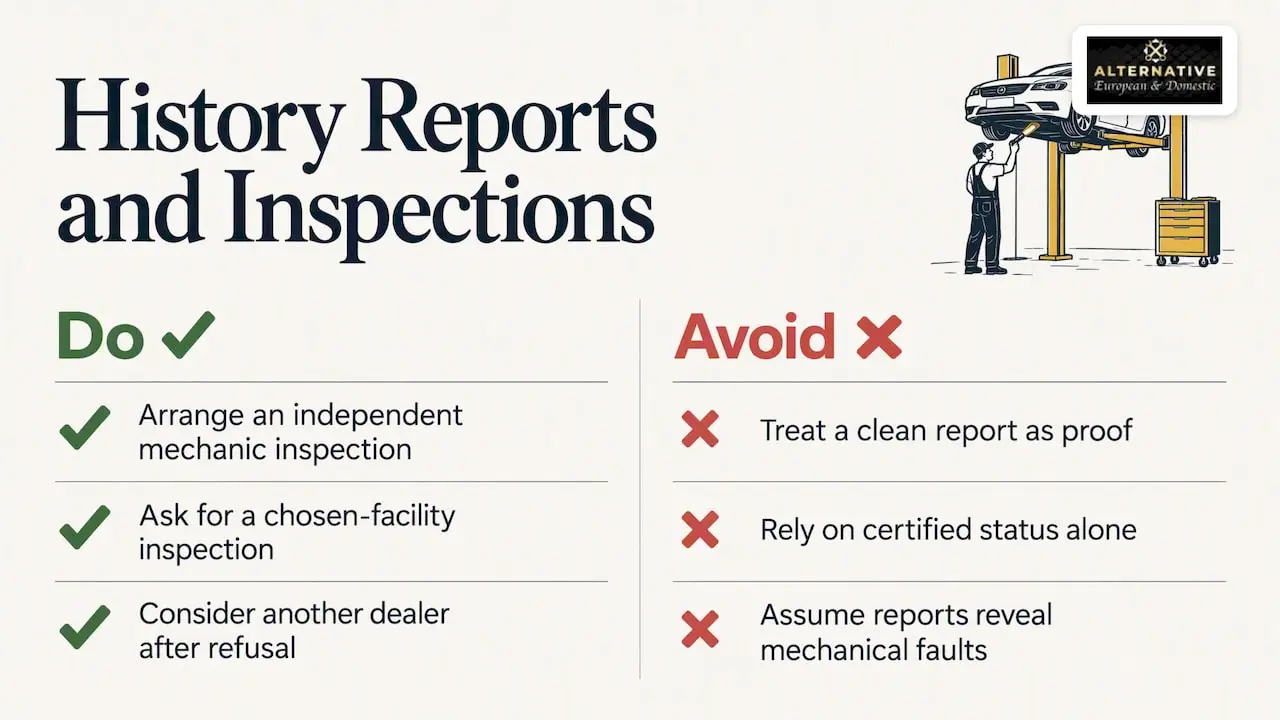
The Federal Trade Commission is direct about both. Its dealer guide says history reports may show accidents or flood damage but typically do not show mechanical problems. It also recommends an independent inspection even when a car is dealer-certified, dealer-inspected, or sold with a warranty or service contract.
That matters on European cars in particular. A worn suspension bushing, a failing transmission mechatronic unit, a weak battery that triggers a cascade of warning messages or an early oil leak will not appear on any report. They appear on a lift and on a scan tool.
If you are buying from a dealer, the FTC says the dealer should allow an independent mechanic to look at the car. If a dealer refuses an off-lot inspection, the FTC advises asking the dealer to take the car to a facility you choose or considering another dealer. A refusal is information about the car.
What to check yourself before you pay for a PPI
A professional inspection costs money, so screen out obvious losers first. This takes 30 to 45 minutes and no tools beyond a flashlight. It is a screening step, not a replacement for a mechanic. Do not crawl under a car supported only by a jack, and do not run the engine in an enclosed space.
Set up the viewing properly
Consumer Reports recommends inspecting in daylight on a dry day, on level ground, and asking the seller not to drive the car for at least an hour beforehand so a cold start and any defects are easier to spot. It also suggests bringing gloves, a rag or paper towels and a flashlight.
Paperwork first
The FTC’s used-car guide recommends obtaining maintenance records, checking for unrepaired recalls by VIN through NHTSA, and reviewing title, odometer and damage information through NMVTIS or another trusted history source. Do this before you drive across town. A salvage or rebuilt title, an unexplained mileage gap or an open recall is a reason to stop or reprice.
Walk-around checklist
- Panel gaps and paint: uneven gaps, overspray on rubber seals or mismatched sheen suggest bodywork. If you find it, a collision repair evaluation of the car’s structure is worth the money.
- Tires: uneven wear across a tire points to alignment or suspension problems. Mismatched brands on an all-wheel-drive car can strain the drivetrain.
- Fluid on the ground or engine: wet seams around the valve cover, oil pan or transmission are worth noting for the mechanic.
- Cold start: listen for rattle, rough idle or smoke. Check that no warning lights stay on after startup.
- Electronics: run every window, seat, mirror, display, camera and the climate control. Intermittent faults are common on modern cars, and a warm A/C at idle can signal expensive repairs.
- Interior wear versus mileage: a worn driver’s seat bolster and steering wheel on a car showing low miles deserves a question.
Test drive with a purpose
The FTC recommends test-driving under varied conditions, including hills, highways and stop-and-go traffic. In the DFW area, that can mean a stretch of Central Expressway or the Dallas North Tollway for sustained speed, then surface streets around Oak Lawn or Uptown for low-speed stop-and-go. Pay attention to:
- Shift quality at low speed and under hard acceleration.
- Brake feel, pulsation or pulling when you stop firmly.
- Steering that wanders or a vibration at highway speed.
- Clunks over bumps and expansion joints, which can point to worn suspension components or engine mounts.
- Temperature gauge behavior in traffic.
What a professional PPI should cover
The scope varies by shop, so ask for it in advance. A thorough inspection on a European or performance car should include the items below.
| Area | What the technician does | Why it matters |
|---|---|---|
| Diagnostic scan | Reads stored and pending fault codes from all control modules, not just the engine computer | Finds faults that have not yet lit a dashboard warning, and codes that were recently cleared |
| Engine | Checks for leaks, belt and hose condition, cooling system, mounts, spark-ignition and fuel-trim data | Oil and coolant leaks are common and costly on turbocharged engines |
| Transmission and drivetrain | Reviews fluid condition and leaks, shift behavior, differential and driveshaft components | Repairs here are among the largest on any used luxury car |
| Brakes | Measures pad and rotor thickness, inspects calipers, lines and fluid | Rotor and pad replacement cost varies widely by model and rotor type |
| Suspension and steering | Checks bushings, control arms, ball joints, shocks or dampers, and alignment wear patterns | Worn parts affect safety and tire life |
| Electrical | Tests battery, charging system, and checks for abnormal parasitic draw | Weak batteries cause cascading warnings on late-model European cars |
| A/C and cooling | Checks cooling performance and for leaks | A/C repairs can be expensive on modern systems |
| Body and frame | Looks for repair evidence, rust and frame distortion | Structural repairs affect safety and resale value |
| Road test | Loads the car under varied driving conditions | Reveals faults that only appear when warm or under load |
A scan tool is the difference between an inspection and a visual check. Dealer-level diagnostic software can read modules and data that generic code readers miss, which is why who performs the scan matters. Our guide on choosing between dealer diagnostics and an independent shop explains the trade-offs, and our piece on advanced electrical diagnostics shows what that kind of testing looks like in practice.
BMW pre-purchase inspection: records and diagnostics that matter
BMW publishes what its own certified pre-owned program checks, and it is a useful template for a private-party or independent PPI. BMW’s 2023 U.S. certified inspection checklist reviews the Condition Based Service (CBS) printout and the BMW North America service-history printout. It also covers open campaigns or stop-sale status, accident and body-repair history, and a possible instrument-cluster replacement that could affect true mileage. The same document covers tire tread and sidewalls, brakes, mechanical systems, diagnostic faults, stationary functions and road-test performance.
Translated into a buyer’s checklist for any BMW (and similar European models):
- Ask for the CBS and service-history data. An authorized BMW center can often print service history by VIN. Gaps in oil service are a concern on turbocharged engines.
- Ask about the instrument cluster. A replaced cluster is not automatically a problem, but the mileage on the car should be documented and reconcile with service records.
- Request a full-module scan. Stored faults in the transmission, stability control, airbag or body modules can point to problems the dash is not yet showing.
- Check for open campaigns and recalls. Use the VIN with NHTSA, and ask the seller about any work performed.
- Test the battery and charging system. On late-model BMWs, a weak battery or an unregistered replacement can create odd electrical behavior. See our notes on increased battery discharge in BMWs and what a battery warning light means.
- Look for leaks. Valve cover, oil filter housing and cooling system leaks are worth identifying and pricing before you buy.
- Drive it through all modes. Shift quality in automatic and manual modes, and any hesitation or harshness, should be noted. If the transmission shows symptoms, ask about mechatronic unit failure before you proceed.
If you are comparing several BMWs, run the same inspection on each so the reports are comparable. A slightly higher asking price on a car with documented service is often cheaper than a bargain with an unknown past.
Porsche pre-purchase inspection: what to ask for
A Porsche inspection follows the same structure, with a few areas that deserve extra attention. Model-specific failure patterns vary a great deal by generation and engine, so ask the technician which items apply to the exact car you are considering instead of relying on a generic list.
- Documented service history. Look for regular oil service, brake fluid changes and records of major scheduled work. Missing records are a negotiating point and a risk.
- Manufacturer-level scan. A full-module read-out matters on cars with complex stability, suspension, hybrid or all-wheel-drive systems.
- Drivetrain behavior. Whether the car has a dual-clutch automatic or a manual, the shifts at low speed and under load should be smooth, without shudder, slipping or noise. Differential and transfer-case fluid service is easy to overlook; our differential fluid interval guide explains why it matters.
- Brakes. Some performance Porsches have carbon ceramic rotors, which have very different inspection and replacement considerations from iron rotors. Read our carbon ceramic brakes guide and ask the seller which rotors the car has. For standard brakes, see our brake pad replacement timing guide.
- Track use and accident evidence. Uneven tire wear, fresh underbody coating in odd places, brake dust patterns and repaired suspension components can point to hard use or past damage. Ask directly and ask for receipts.
- Engine-specific known issues. Some engines from certain years have well-publicized weak points. A technician familiar with the model can tell you what to look for, and a seller who has had the work done should have invoices.
A caution applies to every high-performance car: a clean, polished engine bay is not proof of care. It can be, but it can also hide leaks. Evidence in the paperwork beats appearance.
What a PPI costs and how long it takes
Prices vary by shop, vehicle and scope. As one reference point, RepairPal estimates the average cost of a BMW 328i pre-purchase inspection at $220 to $322 (estimate updated June 2026), and says inspections usually take about an hour, though they can range from 30 minutes to a couple of hours. Exotic or high-performance models, and inspections that include a deeper scan and road test, may cost more because they take longer and need specialized tools.
Cost factors to ask about up front:
- Whether the quote includes a full-module diagnostic scan.
- Whether the shop will put the findings in writing with photos.
- Whether a road test is included.
- What happens if the shop finds a fault that needs more testing. Our guide to the diagnostic fee explains how shops typically charge for that extra testing.
Who pays is normally the buyer. Some sellers offer to cover or split it on a car they are confident in. Either way, the inspection should be done by a shop you choose.
Red flags that should stop the purchase
Some findings are negotiating points. Others are reasons to leave.
- The seller will not allow an independent inspection. The FTC’s advice for dealers applies in spirit to private sellers too. Move on.
- Stored codes that were recently cleared. A scan can show that monitors have not completed, which suggests someone reset the system shortly before sale.
- Structural or frame damage. Repairs here can compromise safety and value.
- Mileage that does not reconcile with service records, cluster replacement history or wear.
- Flood evidence: silt in seat tracks, damp carpets, corroded connectors or a musty smell. Texas has had major flooding events, and water-damaged electronics can fail unpredictably.
- Safety-critical faults: worn brakes, steering play, severe suspension wear or an active airbag fault. These cars should not be driven further than necessary. If you are buying one anyway after repricing, arrange a tow or have the seller deliver it, rather than risking the drive.
- Transmission slipping, harsh shifting or overheating. Continued driving can turn a repair into a replacement.
How to use the report
Treat the written report as three lists.
- Safety and must-fix items. Brakes, tires, steering, suspension, airbag and stability faults. Require the seller to fix them with receipts, or lower the price by the full repair estimate.
- Near-term items. Fluid services, aging belts, mounts, a battery near the end of its life. Ask for a quote from the inspecting shop and negotiate part of that amount.
- Watch items. Minor seepage, cosmetic wear. Budget for them but do not let them derail the deal.
Ask the shop to give estimated repair costs for items one and two, not just a description. A buyer who arrives with numbers has a much stronger position than one who says the car “needs some work.” If you want to know what to ask, our guide on questions to ask a mechanic covers getting findings in writing.
A clean report is also useful. It confirms the price is fair and gives you a baseline for your first maintenance plan.
Book a PPI with Alternative European & Domestic
Alternative European & Domestic works on European, domestic and high-performance vehicles in Dallas, with ASE-certified technicians and dealer-level diagnostics. If you are considering a used BMW, Porsche or other performance car, we can discuss scheduling an inspection and diagnostic evaluation before you sign. If you buy the car, we can set up a maintenance plan around what the inspection found. Browse the full list of services or schedule an appointment and tell us the make, model and year you are looking at.
Our 24-month/24,000-mile warranty applies to qualifying repairs, subject to applicable terms, so ask us what would be covered if repairs follow your inspection.
FAQ
What is a pre-purchase inspection?
It is an inspection by an independent mechanic before you buy a used car. It typically includes a visual check of the body, interior, underbody and mechanical systems, a diagnostic scan and a road test. The goal is to identify existing problems, likely upcoming repairs and anything unsafe.
How much does a BMW or Porsche pre-purchase inspection cost?
RepairPal’s estimate for one BMW model, the 328i, is $220 to $322 on average, and prices vary by shop, vehicle and scope. High-performance models usually cost more because the inspection takes longer and needs specialized scan tools. Ask each shop what the quote includes before you book.
Do I still need a PPI if the car is certified or has a clean history report?
Yes. The FTC recommends an independent inspection even when a car is certified, dealer-inspected or sold with a warranty. History reports may show accidents or flood damage but typically do not show mechanical problems.
Can I do a pre-purchase inspection myself?
You can screen a car yourself by checking records, recalls, the body, tires, electronics and a varied test drive. That helps you rule out bad cars, but it cannot replace a lift inspection and a full-module scan by a technician who knows the make. Do not attempt underbody checks without proper support and safety equipment.
Sources
- How Does a Pre-Purchase Inspection for Cars Work? (NerdWallet)
- Buying a Used Car from a Dealer (FTC, 2023)
- Buying a Used Car (FTC)
- Buying a Used Car From a Dealer (FTC Consumer Advice)
- How to Inspect a Used Car to Avoid Costly Repairs (Consumer Reports)
- Vehicle Inspection Checklist (BMW USA, 2023)
- BMW 328i Pre-Purchase Car Inspection Cost (RepairPal)