
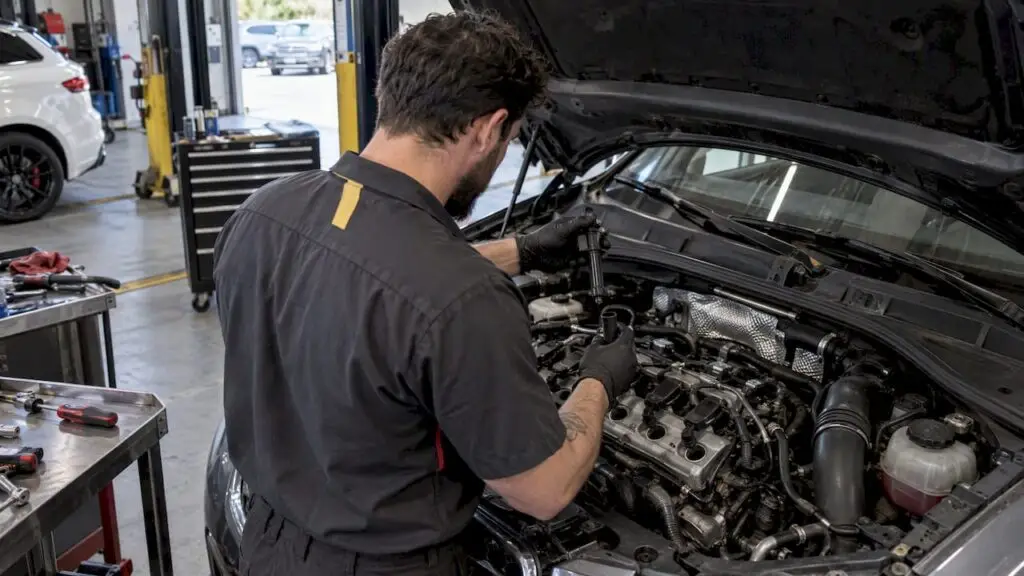
An engine misfire happens when a cylinder fails to combust fuel at the right moment, and it needs attention fast. If you feel shaking at idle, sense a stumble under load, or see a flashing check engine light, limit your driving and read the codes before you go any further. A scan tool reading is the fastest way to know whether you are looking at a simple fix or something that needs a shop.
TL;DR:
- A misfire caused by ignition issues often shows in spark plug condition and can be diagnosed with oscilloscope waveform analysis for accurate identification.
- Fuel trim and vacuum leak testing help distinguish between fuel delivery problems and mechanical compression issues, guiding targeted repairs.
- A flashing check engine light indicates severe misfires that threaten the catalytic converter and require immediate professional diagnosis and repair.
- Intermittent misfires may not trigger persistent codes but can be traced by logging live data during symptom conditions over a longer drive cycle.
- Advanced diagnostics, including compression tests and scope analysis, are essential for precise troubleshooting in turbocharged, diesel, or weather-affected engine misfires.
Table of Contents
- Symptoms: What a Misfire Feels and Sounds Like
- How OBD-II Detects a Misfire and What the Codes Mean
- Ignition, Fuel, or Compression: Narrowing Down the Cause
- A Step-by-Step Diagnostic Workflow That Avoids Guesswork
- Safe DIY Checks Before You Head to a Shop
- Why Dealer-Level Diagnostics Matter When DIY Checks Run Out
- How Temperature and Humidity Affect Misfires
- Why Ignition Timing Matters for Preventing Misfires
- Diagnosing Misfires in Turbocharged and Diesel Engines
- Using an Oscilloscope to Confirm What a Scan Tool Can’t Show
- Our Take: Diagnose First, Replace Second
- Book a Diagnostic Appointment for Your Misfire
- FAQ
- Sources
Symptoms: What a Misfire Feels and Sounds Like
A misfire at idle usually shows up as a rough, uneven shake you can feel through the seat or steering wheel. Under load, it often feels different: a hesitation when you accelerate, a brief loss of power, or a stumble as the engine struggles to keep cylinders firing in sequence. Some misfires are audible before they are ever felt, producing popping sounds, a backfire through the exhaust, or an exhaust tone that goes uneven instead of steady.
The check engine light tells you how urgent the situation is:
- A steady check engine light usually means the issue has been logged but isn’t causing immediate damage.
- A flashing check engine light signals an active misfire severe enough to risk the catalytic converter.
- Rough idle combined with a smell of unburned fuel often points to a cylinder that isn’t firing at all.
- Loss of power under hard acceleration, especially paired with a flashing light, means you should stop driving and get the car scanned.
Unburned fuel from an active misfire can overheat and damage the catalytic converter, which is why a flashing check engine light warrants immediate attention rather than a wait-and-see approach.
How OBD-II Detects a Misfire and What the Codes Mean
Your engine’s computer does not see combustion directly. It tracks tiny fluctuations in crankshaft speed, since a misfire produces a measurable dip in crankshaft angular velocity that the computer compares against speed and load-based thresholds. When a cylinder’s roughness crosses that threshold enough times, a code sets.
P0300 means the computer cannot pin the misfire to one cylinder, which often points to a system-wide problem rather than one bad part. P0301 through P0308 identify a specific cylinder, narrowing the search considerably. Useful data to pull with a scan tool includes:
- Misfire counters per cylinder, which show frequency and which cylinders are affected.
- Short-term and long-term fuel trim, which hint at lean or rich conditions.
- Oxygen sensor or air-fuel ratio data alongside freeze-frame snapshots of conditions when the code set.
- Mode 6 data where your scan tool supports it, for a closer look at the test values behind the code.
Intermittent misfires sometimes never set a persistent code, so logging live data over a longer drive, matching the conditions where the symptom occurs, is often necessary to catch them.
Ignition, Fuel, or Compression: Narrowing Down the Cause
Nearly every misfire traces back to one of three systems, and each leaves its own clues.
Ignition problems include worn spark plugs, failing coils, cracked boots, or carbon tracking inside the distributor or coil pack. A plug that is gray and dry usually points elsewhere, while one that looks oily, sooty, or eroded at the electrode suggests an ignition or combustion issue worth a closer look.
Fuel-related causes include dirty or clogged injectors, low fuel pressure, vacuum leaks, and a leaking EGR valve. These tend to show up in fuel trim data before anything else. Random misfires frequently trace back to vacuum leaks, a failing EGR valve, or low fuel pressure, and a short-term fuel trim reading significantly above normal commonly signals a lean condition worth chasing down.
Compression problems are mechanical: burned valves, a failing head gasket, or worn rings. A compression test or a wet compression test (adding oil to the cylinder before retesting) separates valve problems from ring wear, since oil temporarily seals worn rings and raises the reading.
- Check whether the code is cylinder-specific (points toward ignition or a localized mechanical fault) or random (points toward a system-wide fuel or vacuum issue).
- Compare fuel trim trends at idle versus higher rpm to separate vacuum leaks from fuel-delivery problems.
- Pull a plug before assuming anything. Its condition rules out or confirms an ignition suspicion quickly.
- Run a compression test whenever ignition and fuel checks come back clean.
Pro Tip: If short-term fuel trim drops noticeably when you rev the engine to 1,500 to 2,000 rpm, suspect a vacuum leak rather than a fuel delivery fault, since vacuum leaks have less relative effect at higher airflow.
A Step-by-Step Diagnostic Workflow That Avoids Guesswork
A disciplined sequence saves time and keeps you from replacing parts that were never the problem.
- Capture codes and freeze-frame data along with notes on when the misfire happens: cold start, highway speed, acceleration, idle.
- Review fuel trims. A short-term fuel trim reading significantly above normal typically indicates a lean condition, which should point you toward vacuum leaks or fuel delivery before you touch ignition parts.
- Run a swap test. Move a coil or injector between cylinders and watch whether the misfire code follows the part or stays with the cylinder; this isolates a component-specific fault from a cylinder-specific one without any disassembly.
- Check fuel pressure and, if it reads low or uneven, test injector flow or pressure drop across each cylinder.
- Inspect spark quality, including plug condition, secondary ignition parade patterns, and oscilloscope traces where that tool is available.
- Run a compression or wet compression/leakdown test once ignition and fuel have been ruled out, to confirm or eliminate a mechanical cause.
- Verify the repair with a fresh scan, a drive cycle matching the original symptom conditions, and confirmation that readiness monitors have completed.
That last step matters more than most DIYers expect. Monitor enabling criteria can prevent a misfire code from reappearing or clearing properly even after a real repair, so skipping the drive cycle can leave you guessing whether the fix actually worked.
Safe DIY Checks Before You Head to a Shop
A handful of low-risk checks can save a diagnostic visit or at least arm your shop with useful information.
- Pull a spark plug and look at it: wet and fuel-smelling points to a non-firing cylinder, oily suggests oil intrusion, and heavy black soot suggests a rich-running condition.
- Look over visible vacuum hoses for cracks, and listen near the intake with the engine running for a hissing sound that suggests an air leak.
- Listen for a faint buzzing or clicking from each injector with a mechanic’s stethoscope or even a long screwdriver held to your ear.
- Check battery terminals and charging voltage, since a weak charging system can cause erratic ignition behavior that looks like a misfire.
Pro Tip: Avoid working on pressurized fuel lines or pulling modern coil-on-plug assemblies apart without the right tools; both carry real risk of fuel exposure or electrical damage if done carelessly.
Why Dealer-Level Diagnostics Matter When DIY Checks Run Out
Some misfires resist a quick fix. We use oscilloscope analysis, fuel pressure and flow testing, and compression or leakdown testing to separate ignition, fuel, and mechanical causes with precision rather than trial and error. After any repair, we confirm it with a post-repair scan, a drive cycle, and a check that readiness monitors have completed, so you leave with a fix that is actually verified, not just assumed.
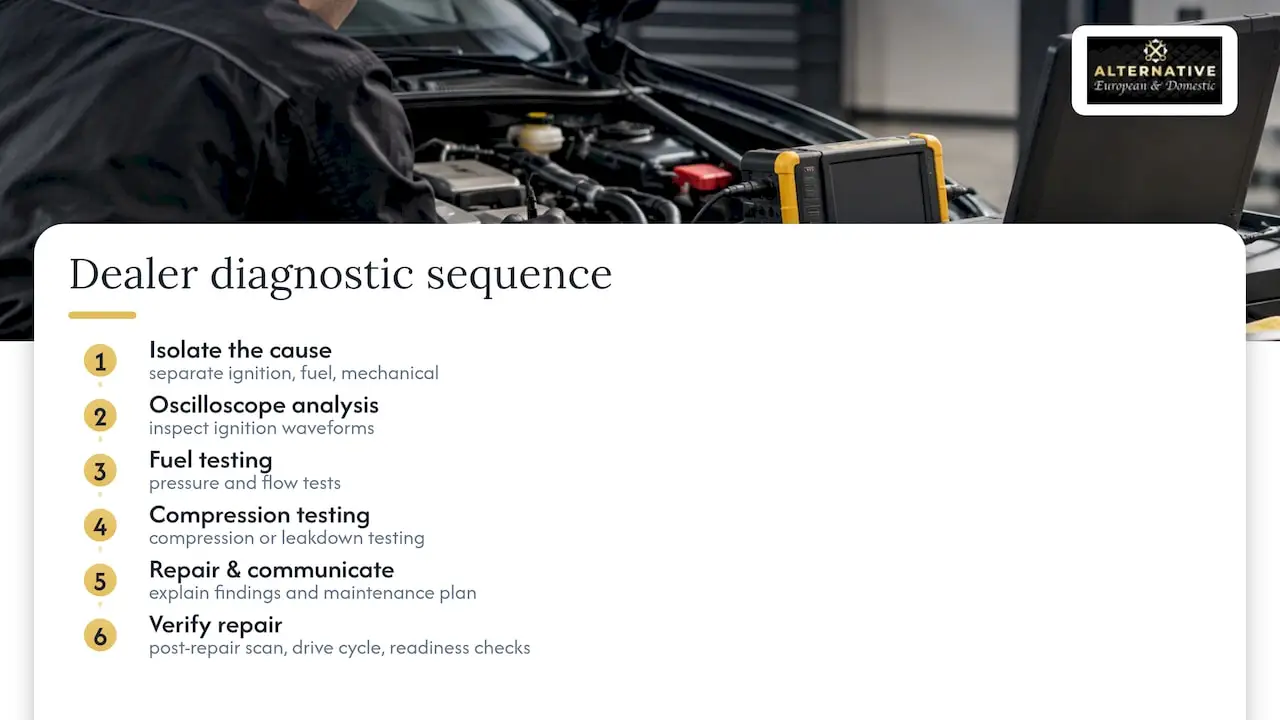
Our diagnostic process involves clear communication about what we find and maintenance plans built around your specific vehicle. A flashing check engine light, a misfire affecting multiple cylinders, low compression, or an intermittent “ghost” misfire that won’t reproduce on command are all situations where advanced diagnostic tools make the difference between an accurate fix and a guess.
How Temperature and Humidity Affect Misfires
Weather conditions change how forgiving your engine is of marginal ignition or fuel components. Cold starts demand more from spark plugs and coils, since colder air is denser and requires a stronger spark to ignite the same fuel charge. A borderline coil or plug that behaves fine in warm weather can misfire reliably on a cold morning.
Humidity plays a role too, particularly with ignition components that are already aging. Moisture that works its way into a cracked spark plug boot or a corroded coil connector can cause arcing that shows up only in damp conditions and disappears once things dry out. This is one reason some misfires seem to come and go with the weather rather than with mileage or driving style.

Heat has its own effect, especially on fuel delivery. High underhood temperatures can accelerate vapor formation in fuel lines on older designs or stress injector seals, and a vacuum leak that is barely noticeable in cool weather can widen slightly as rubber and plastic components expand with heat.
None of this means weather causes a misfire on its own. It means that borderline parts, a coil nearing the end of its life, a boot with a hairline crack, a vacuum line that has started to harden, tend to fail at the margins first, and temperature or humidity swings often expose that margin before anything else does. If your misfire seems to track with weather changes, it is a strong clue that you are dealing with a component right at the edge of failure rather than a sudden new problem.
Why Ignition Timing Matters for Preventing Misfires
Spark timing is not just about performance. It is about making sure each cylinder fires its charge at the precise point in the compression stroke where combustion happens cleanly and completely. When timing drifts, whether from a failing crankshaft or camshaft position sensor, a stretched timing chain, or an incorrect reinstallation after a repair, combustion becomes inconsistent even when the spark itself is strong and the fuel mixture is correct.
Modern engines manage timing electronically, adjusting it continuously based on load, rpm, and knock sensor feedback. A sensor that reports bad data can push timing out of its ideal window without throwing an obvious code at first, and the misfire that results can look identical to a fuel or ignition fault on a basic scan.
This is part of why a cylinder-specific misfire code does not always mean a cylinder-specific ignition part is at fault. A timing-related cause tends to show a pattern across cylinders that worsens under load or at specific rpm ranges, rather than a single random dead cylinder. When basic ignition and fuel checks come back clean but the misfire persists, especially under acceleration, checking cam and crank sensor data and confirming timing alignment becomes the next logical step before assuming a mechanical failure.
Diagnosing Misfires in Turbocharged and Diesel Engines
Turbocharged engines add a layer to misfire diagnosis because boost pressure changes the conditions under which a weak component fails. A coil or plug that handles naturally aspirated combustion fine may struggle once boost pushes cylinder pressure higher, which is why some turbo misfires only appear under load or hard acceleration and vanish at idle. Checking boost pressure alongside fuel trim and misfire counters helps confirm whether the fault is load-dependent.
Direct-injection turbo engines also face carbon buildup on intake valves more readily than older port-injected designs, since fuel no longer washes over the valves on its way into the cylinder. That buildup can disrupt airflow unevenly across cylinders and produce a misfire pattern that looks electrical at first glance but is actually a fouling issue.
Diesel engines do not misfire in the traditional spark-ignition sense, since combustion relies on compression rather than spark. What drivers describe as a diesel “misfire” is usually a fuel delivery problem: a failing injector, air in the fuel system, or a glow plug issue affecting cold-start combustion in one cylinder. Diagnosis shifts toward injector balance tests, fuel pressure readings specific to the high-pressure common rail system, and glow plug circuit checks rather than spark-related tools.
Across both engine types, the same principle from gasoline diagnostics still applies: isolate whether the problem follows a specific cylinder or shows up system-wide, then test the components most likely to explain that pattern before replacing parts.
Using an Oscilloscope to Confirm What a Scan Tool Can’t Show
A scan tool tells you that a misfire happened. An oscilloscope shows you why, by capturing the actual electrical signal in real time rather than a summarized code. For ignition diagnosis, technicians look at the secondary ignition “parade” pattern, essentially a side-by-side waveform of every cylinder’s spark event, to spot one cylinder burning differently from the rest.
A healthy cylinder at idle typically shows a spark burn line of roughly 1.3 milliseconds or more. A burn line shorter than about 0.75 milliseconds often points to a lean mixture or low compression, while a much longer burn duration suggests an overly rich condition. These patterns give a clearer answer than a swap test alone when the swap test result is ambiguous or when multiple cylinders show marginal readings.
Oscilloscopes also help with fuel injector diagnosis, by capturing the voltage and current waveform as an injector opens and closes. A sluggish or inconsistent waveform can reveal a sticking injector that still passes a basic resistance check. This kind of testing takes more setup than reading a code, but it answers the question a parts-swap test sometimes cannot: whether the real issue is weak spark, a lean mixture, or a rich one, each of which points toward a different fix.
Our Take: Diagnose First, Replace Second
We approach every misfire the same way: find the actual cause before any part comes off the car. That means pulling codes, reviewing live data, and confirming a fault with a test rather than a guess. If you bring in your stored codes, a photo of the dash warning light, and notes on when the misfire happens, we can usually narrow the cause faster and give you a clear estimate before any work begins.
— Alternative European & Domestic
Book a Diagnostic Appointment for Your Misfire
A misfire rarely fixes itself, and guessing at parts gets expensive fast. Our diagnostic process covers a full scan, cylinder and fuel system inspection, a repair estimate based on what we actually find, and a verification plan once the work is done.

Whether the cause turns out to be ignition, fuel, or something deeper in the engine, you can schedule a diagnostic scan or move straight into engine repair services if a mechanical issue is already suspected. For routine upkeep that helps prevent misfires before they start, our maintenance services page covers scheduling for ongoing inspections.
FAQ
Is a misfire expensive to fix?
Cost depends entirely on the cause: a worn spark plug or coil is a modest repair, while a failed head gasket or internal mechanical damage costs considerably more. We don’t quote repair costs without a diagnosis first, since replacing the wrong part based on a guess almost always costs more in the end.
Can I still drive if my engine is misfiring?
A steady check engine light with mild symptoms is usually safe for a short drive to a shop, but a flashing light means you should stop driving as soon as it’s safe to do so. Unburned fuel from an active misfire can overheat the catalytic converter, turning a repair into a much bigger one.
What are the three most common causes of a misfire?
Misfires generally trace back to ignition components like worn plugs or coils, fuel-related issues like vacuum leaks or low fuel pressure, or compression problems like a burned valve or failing head gasket. Random misfire codes often point toward vacuum leaks, EGR problems, or low fuel pressure before a mechanical cause is considered.
How do you fix a misfire in an engine quickly?
The fastest real fix comes from diagnosing first: read the codes, check fuel trims, and run a swap test to confirm whether a coil, injector, or plug is at fault before replacing anything. Skipping that step and swapping parts at random often wastes money without solving the actual problem.
What scan tool data helps diagnose a random misfire?
Misfire counters per cylinder, short and long-term fuel trim, and freeze-frame data captured at the moment the code set are the most useful starting points. For intermittent misfires that don’t set a persistent code, logging live data over an extended drive matching the symptom conditions often catches what a single scan misses.